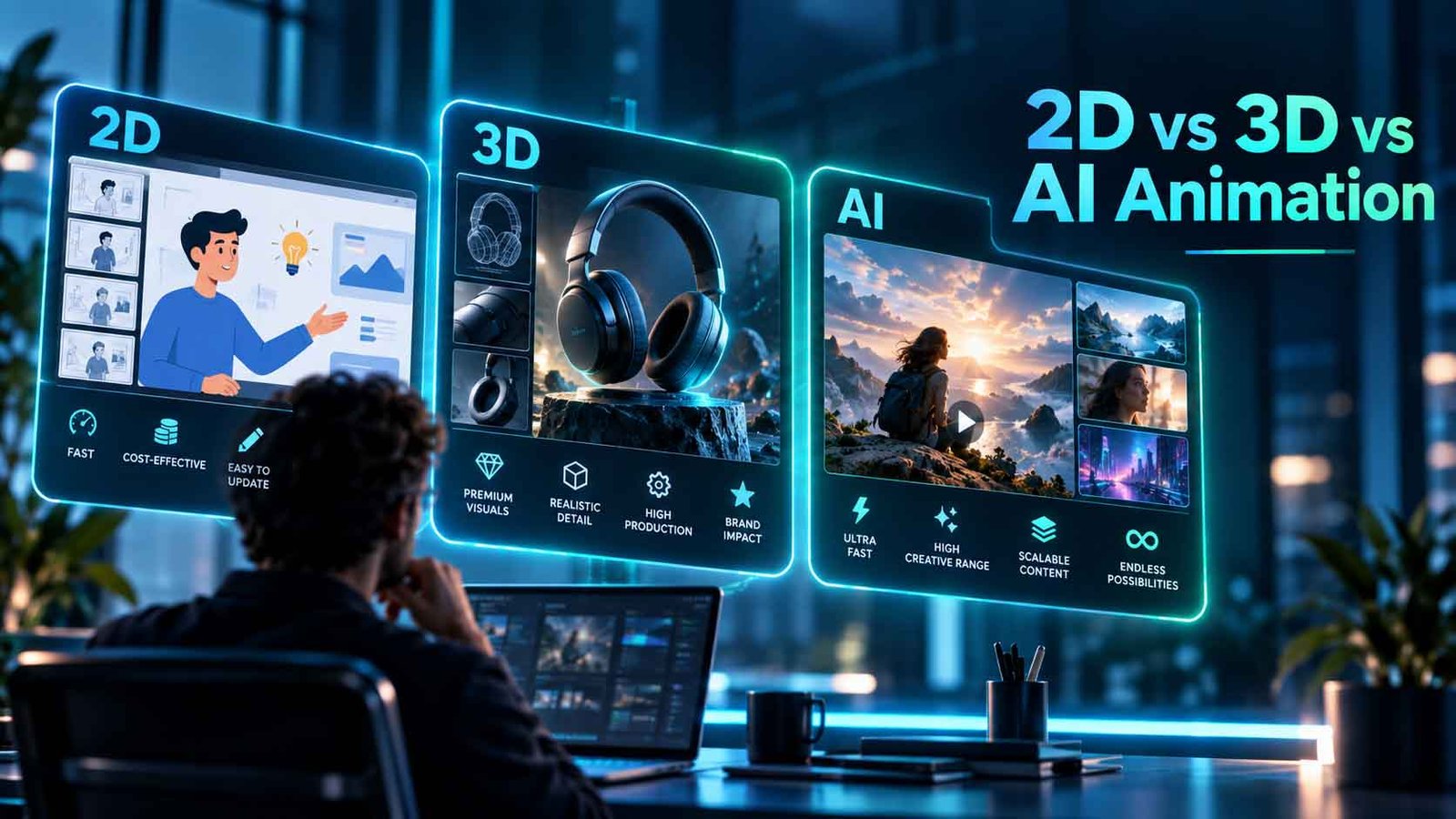
Choose 2D when you need to explain something clearly on a normal budget and timeline. It is the default for software, services and processes. Choose 3D when the physical object is the story: products, machinery, architecture, or anything with internal structure the viewer needs to see. Choose AI-powered animation when speed and volume matter more than frame-level control, such as social campaigns and ad variants. 2D is the cheapest to revise, 3D the most expensive to produce, AI the fastest to deliver.
On this page
The comparison at a glance
| Factor | 2D animation | 3D animation | AI-powered |
|---|---|---|---|
| Relative cost | Moderate | Highest | Lowest custom tier |
| Production time | 4 to 8 weeks | 8 to 12 weeks | 1 to 2 weeks |
| Revision flexibility | High. Change a scene, not the pipeline | Low. Late changes can force re-render | Medium. Regeneration is fast but imprecise |
| Brand colour accuracy | Exact | Exact | Approximate, needs direction passes |
| Best at | Abstract ideas, processes, software, services | Physical objects, scale, internal structure | Atmosphere, volume, campaign variants |
| Weakest at | Conveying real physical form | Abstract concepts, tight budgets | Exact repeatability across scenes |
| Character consistency | Perfect, characters are built assets | Perfect, characters are rigged models | Requires deliberate control, still improving |
| Localisation cost | Low if planned | Low if planned | Low |
| Typical use | Explainers, onboarding, training | Product launch, architecture, engineering | Social, ads, brand films, concept tests |
When 2D is the right answer
2D animation is the default for a reason. Most business video has to explain something that does not physically exist: a workflow, a service, a piece of software, an idea. 2D handles abstraction natively. You can draw a metaphor in 2D. You cannot easily model one in 3D.
It is also the most forgiving format commercially. Scenes are independent, so changing scene four does not touch scene five. That keeps late revisions cheap, which matters more than most buyers realise at the quoting stage.
Choose 2D when:
- The subject is a process, service, concept or piece of software
- You need a clear explanation more than a spectacle
- The budget is real but not unlimited
- You expect stakeholder feedback and want changes to stay affordable
- You are producing a series and want to reuse characters and assets
When 3D is worth the money
3D animation costs more and takes longer for a specific reason: you build the world before you film in it. Modelling, texturing, rigging, lighting and rendering all happen before animation begins. That fixed cost is wasted on a subject that has no physical form, and indispensable on one that does.
The test is whether the viewer needs to understand something spatial. How the parts fit. What is inside. How big it is next to a person. How it moves in the real world. If the answer is yes, 3D is not a luxury, it is the only format that communicates it.
Choose 3D when:
- The product is physical and its form is the selling point
- You need cutaways, exploded views or internal mechanisms
- Scale or spatial relationships matter
- The subject is architectural or the space does not exist yet
- The video has to feel premium enough to justify a premium product
When AI-powered animation wins
AI-powered animation changed the economics of the low end of the market, not the high end. Where it wins is volume and speed. Producing eight variants of a social ad for testing used to be an eight-video budget. Now it is close to a one-video budget.
It also unlocked a category that barely existed: atmospheric brand content at a price that does not require a campaign to justify it. Mood, texture, movement and scale that would previously have needed a shoot or a 3D build.
What it does not do well is exact repeatability. Getting the same character, in the same jacket, with the same logo, in eleven consecutive scenes, is where the format still fights you. Human direction on every frame is what makes the difference between AI output and AI-powered production, and it is the reason we treat it as a pipeline rather than a button.
Choose AI-powered when:
- The deadline is measured in days, not months
- You need many variants of a similar idea
- The brief is atmospheric rather than technical
- Budget is the binding constraint
- You are testing a concept before committing to a full production
Where each one fails
Format selection goes wrong in predictable ways. These are the three most common and most expensive.
- 3D chosen for prestige, not need. A SaaS company commissions 3D because it feels premium, then discovers the product is a web interface with no physical form. The result costs three times more and explains less than 2D would have.
- AI chosen for a brief that needs precision. A brand orders AI-powered video for a product demo where the on-screen UI has to be accurate. Getting the interface pixel-correct in a generative pipeline costs more than compositing real screen capture into motion graphics.
- 2D chosen for a physical product launch. An engineering company explains a mechanical assembly in flat illustration. The viewer never understands how the parts relate, because the format cannot show it.
A three-question decision test
Run your brief through these in order. The first "yes" is usually your answer.
- Does the viewer need to understand a physical object in space? If yes, 3D, or 2D with a 3D hero shot.
- Does this need to ship in under three weeks, or do you need many variants? If yes, AI-powered or motion graphics.
- Otherwise: 2D. It will explain the idea more clearly, cost less, and survive stakeholder revisions better than either alternative.
And the answer is allowed to be "more than one". Mixing formats so the expensive technique appears only where it earns its cost is often the most efficient brief of all: 2D or motion graphics to explain, 3D for the hero shot, AI for the social cutdowns.
If you are not sure, tell us the goal, audience and budget and we will recommend a format. That advice is free and carries no obligation, including when the honest answer is a format we would earn less on.