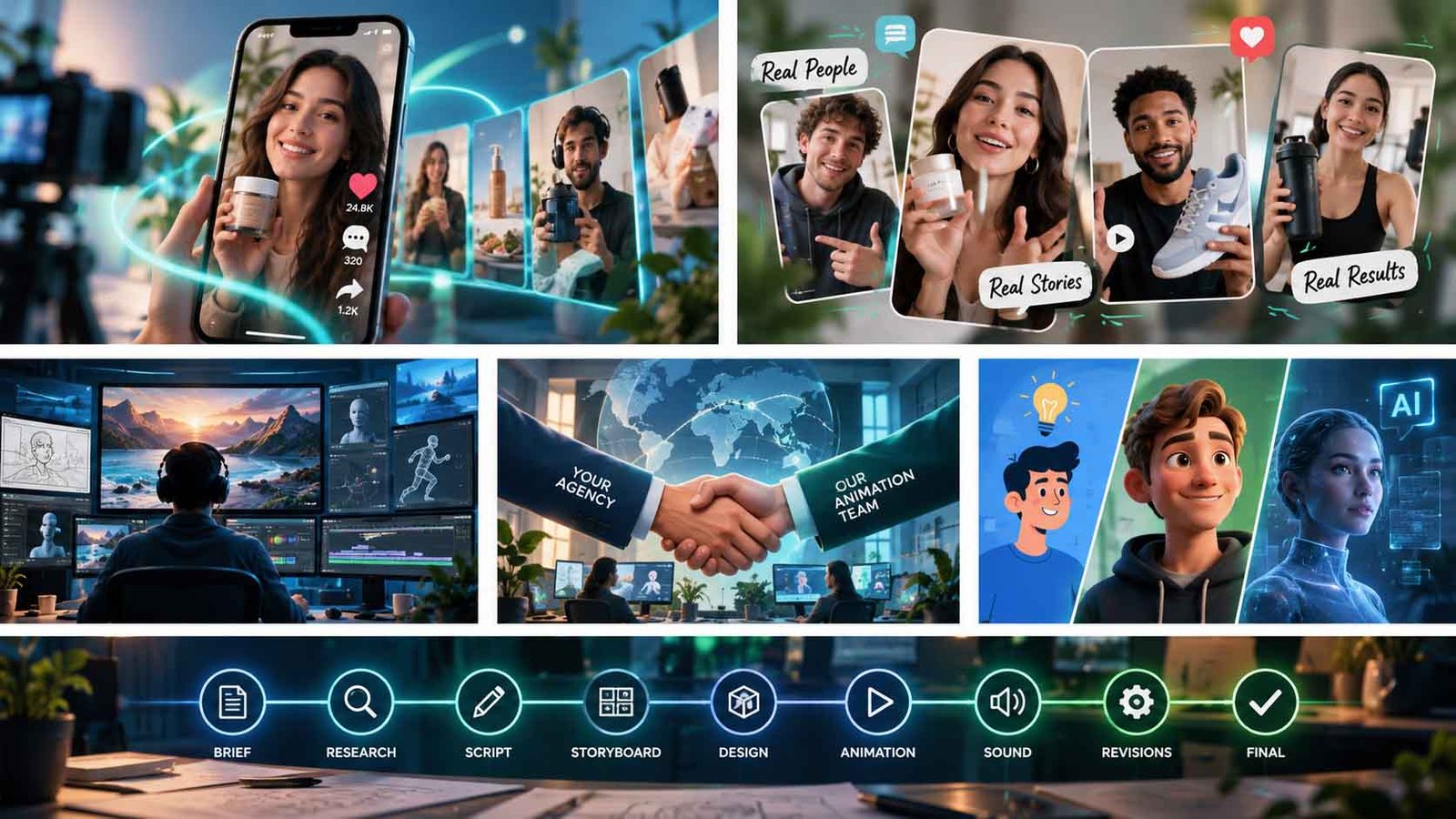
A 60-second 2D animated explainer takes 4 to 8 weeks from brief to final delivery. 3D takes 8 to 12 weeks. AI-powered animation can be delivered in 1 to 2 weeks. About half of that time is pre-production, meaning script and storyboard rather than animation. A rush 2D delivery in 3 to 4 weeks is possible with a locked script, usually at a 20 to 40 percent premium.
Key numbers
- 2D explainer, 60 seconds: 4 to 8 weeks
- 2D character animation: 6 to 8 weeks
- 3D animation, 60 seconds: 8 to 12 weeks
- 3D modelling alone: adds 3 to 6 weeks
- AI-powered video: 1 to 2 weeks
- Rush 2D delivery: 3 to 4 weeks, at a 20 to 40 percent premium
- Client review window that keeps a project on track: 2 to 3 working days per round
On this page
The five stages, and how long each takes
Every animation project runs through the same five stages regardless of style. What changes is how long each one takes. These figures are for a 60-second 2D explainer, which is the most common brief in B2B.
| Stage | Duration | What happens | Who is blocking |
|---|---|---|---|
| 1. Discovery and brief | 2 to 4 days | Goals, audience, message, references, brand assets collected. | Client |
| 2. Script | 1 to 2 weeks | Draft, review, revision, sign-off. Includes the voiceover read timing. | Shared |
| 3. Storyboard and style frames | 1 to 2 weeks | Scene-by-scene visual plan plus 2 to 3 fully designed frames for look approval. | Shared |
| 4. Animation | 2 to 4 weeks | Design build, animation, voiceover record, music and sound design. | Studio |
| 5. Revisions and delivery | 3 to 7 days | Final rounds, format exports, aspect ratio crops, handover. | Shared |
Two observations worth internalising. First, stages two and three together are roughly half the schedule, and neither involves animation. Second, the studio is the sole blocker in only one stage out of five. Animation timelines are mostly a function of how fast decisions get made.
Timeline by animation style
| Style | Standard | Rush possible? | What sets the floor |
|---|---|---|---|
| AI-powered video | 1 to 2 weeks | Days | Generation and direction passes, not frame labour |
| Motion graphics | 2 to 3 weeks | Yes, ~1 week | Design approval |
| Whiteboard | 2 to 4 weeks | Yes, ~2 weeks | Illustration volume |
| 2D flat / infographic | 4 to 6 weeks | Yes, 3 to 4 weeks | Custom illustration build |
| 2D character animation | 6 to 8 weeks | Limited | Rigging and lip sync |
| 3D product / architectural | 8 to 12 weeks | Rarely | Modelling and render time |
Render time deserves a note. In 3D, the final render is machine hours. It is the one part of the schedule that does not compress by adding people or paying more, so a 3D deadline is far less negotiable in the last week than a 2D one.
The three things that actually cause delays
In a decade of production, almost every overrun traced back to one of these. None of them is an animation problem.
1. The script reopens after design has started
This is the expensive one. Storyboards, illustrations, voiceover and timing are all derived from the script. Changing a line in week five does not cost a line, it costs every asset built on top of it. Lock the script with everyone who has veto power in the room, before design begins.
2. Feedback arrives slowly, or contradicts itself
Two stakeholders giving opposite notes in the same round stalls a project harder than a two-week silence, because the studio cannot act on either. Consolidate feedback into one document, from one owner, per round.
3. Nobody knows who has final approval
If approval authority is not named at kickoff, it surfaces at the worst moment, usually when a senior stakeholder sees the video for the first time at the final round. Name the approver on day one.
How to move faster without paying a rush fee
- Send brand assets with the brief. Logo files, fonts, colour tokens, product screenshots. Chasing these costs days.
- Name one approver and one reviewer window. 2 to 3 working days per round is the target.
- Approve the style frame properly. The style frame is where "we want a different look" is cheap. After animation starts, it is not.
- Say yes to the voiceover early. Voice casting sits on the critical path more often than people expect.
- Choose a format that matches your deadline. If the campaign ships in three weeks, that is an AI-powered or motion graphics brief, not a 3D one. Picking the right format is faster than rushing the wrong one.
How we run it
We run the same five-step process on every project: discover, script, storyboard, animate, deliver. Revision rounds are built into each stage rather than saved for the end, which is why a change at storyboard costs nothing and a change at final render costs a week.
Quotes include a delivery date, not a delivery range. Across more than 1,000 projects we have not missed one. If you need a specific date, say so in the brief and we will tell you honestly whether the format you want fits it.