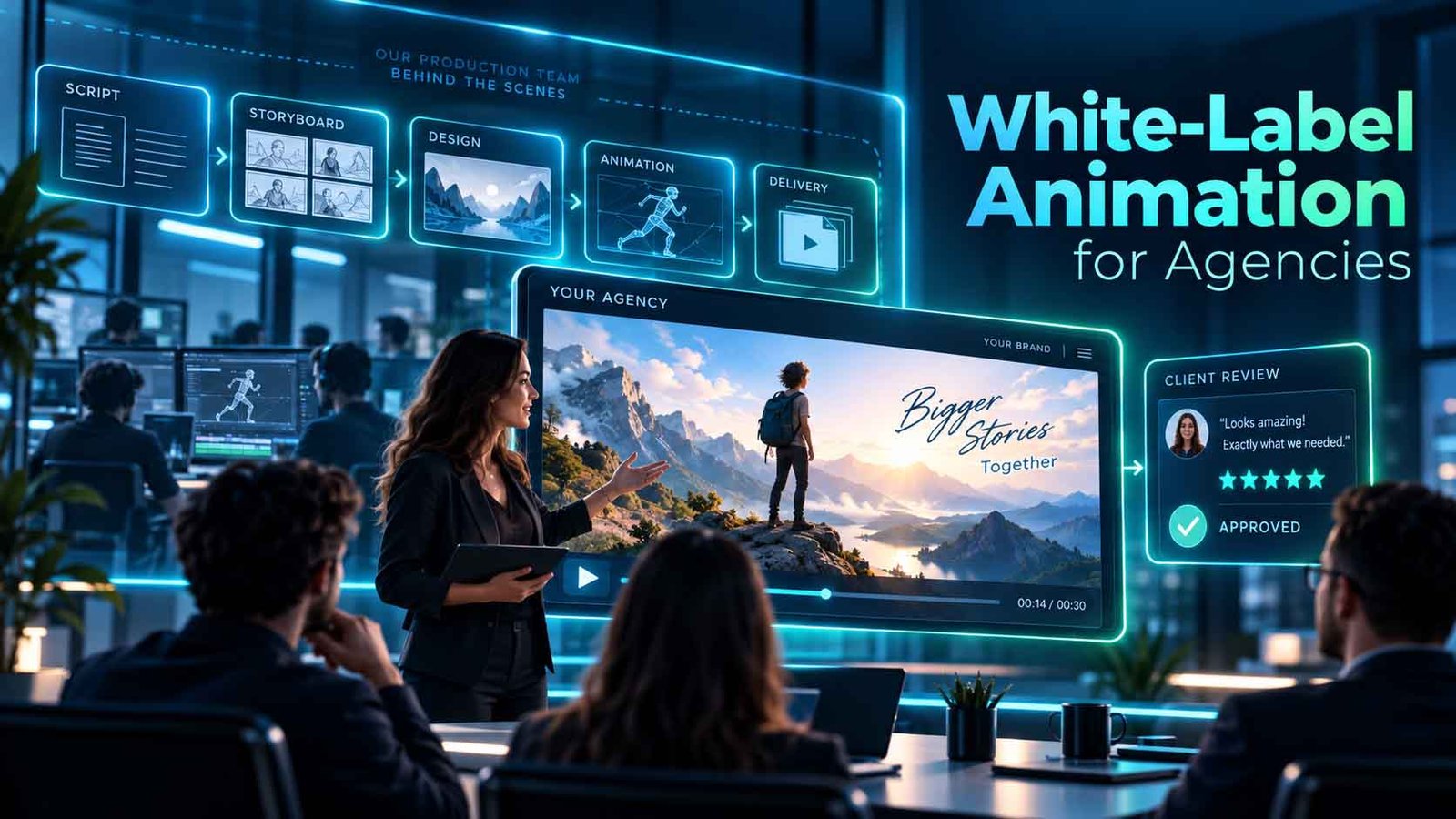
White-label animation is when a production studio makes the video and the agency delivers it to the end client under the agency's own name. The studio never contacts the client, never brands the work, and never takes public credit. Agencies typically mark up white-label production by 40 to 100 percent and use it to offer video without hiring animators, carrying software costs, or turning down briefs outside their in-house skill set.
Key facts
- Typical agency markup: 40 to 100 percent
- What the client sees: the agency's name only
- Who owns the relationship: the agency, always
- Commercial model: pay per project, or a monthly retainer for continuous output
- Main benefit: capacity without headcount
- Main risk to manage: brief quality, because the agency sits between two parties
On this page
Why agencies use white-label production
Animation demand inside an agency is lumpy. Three video projects land in the same month, then nothing for a quarter. Hiring for the peak means paying through the trough. Hiring for the trough means turning work away, or worse, accepting it and missing the date.
White-label production converts a fixed cost into a variable one. It also converts a narrow capability into a broad one, because an in-house animator is usually excellent at one or two styles, while a studio covers the full range. An agency with a white-label partner can say yes to a 3D product brief, a whiteboard training series and an AI-powered social campaign in the same week without hiring anyone.
The less discussed benefit is positioning. Video is often the entry point to a larger retainer. Being able to quote on it keeps the agency in conversations it would otherwise be excluded from.
The economics, compared honestly
| In-house animator | Freelancer per project | White-label studio | |
|---|---|---|---|
| Cost structure | Fixed monthly | Variable | Variable |
| Cost when there is no work | Full | Zero | Zero, or retainer |
| Style coverage | 1 to 2 styles | 1 to 2 per person | Full range |
| Capacity ceiling | One person's hours | Whoever is free | A team |
| Management overhead | High, it is a report | High, re-briefing each time | Low once the process is set |
| Deadline risk | Low, but single point of failure | Highest | Low, contractual |
| Best when | Video is continuous and core | Volume is genuinely rare | Demand is real but uneven |
An in-house animator is the right answer for some agencies. If video is continuous, central to the offer, and the styles needed are narrow and stable, hire. The moment demand is uneven or the style range is wide, the maths turns.
How the margin actually works
The 40 to 100 percent markup is not a middleman tax. It pays for work the studio does not do and cannot do.
- The client relationship. Won, held, and defended by the agency.
- Brief translation. Turning "we need something exciting for the launch" into a producible brief is a skill, and it determines whether the first draft lands.
- Commercial risk. The agency carries payment terms, scope disputes and the client's expectations.
- Strategy and positioning. Frequently the most valuable part, and the part the client is actually buying.
Agencies that go furthest above the 40 percent floor are the ones doing the scripting and strategic work themselves and handing the studio a locked, well-defined production brief. That combination raises the agency's margin and lowers the studio's revision count at the same time, which is why it holds.
What to check before signing a partner
- Attribution in writing. No branding on deliverables, no studio metadata, no portfolio publication without written permission. Get it in the contract, not the sales call.
- Contact rules. Confirm whether the studio will ever contact your client, under any circumstances, including chasing assets.
- Deadline record. Ask for the actual on-time delivery rate, and what happens contractually when a date is missed.
- Style range. Ask for work in the styles you sell, not the ones they like showing.
- Revision policy. Rounds included at each stage, and the cost of an extra round. This is where white-label margin usually leaks.
- Source file ownership. Agree up front. If your client asks for project files in a year, you want a documented answer.
- Communication mode. Full separation, or embedded in your channel under your branding. Decide before the first project.
How the workflow runs
A well-run white-label project has one rule: the client experiences a single supplier. In practice that means the agency owns every touchpoint and the studio operates behind it.
- You send the brief. Goal, audience, message, duration, references, brand assets, deadline.
- We return a fixed price and a delivery date within 24 hours, by email.
- We produce. Script, storyboard, style frames, animation, voiceover, sound design.
- You review at each stage. Either internally first, or by passing our stage deliverable straight to your client under your branding.
- You deliver. Final files, unbranded, in every format required. You present. We are not in the room.
Some agencies keep total separation. Others add us to a shared channel using their domain and branding, effectively as their animation department. Both are fine. Choosing which one before the project starts avoids the awkward mid-project moment where a client asks a question nobody has agreed who answers.
How to write a brief that gets a good first draft
The single highest-leverage thing an agency can do is brief well. A good brief is short. It contains:
- What the video has to make the viewer do. Not the topic. The action.
- Who is watching, and what they already know
- The one message that must survive if everything else is cut
- Duration and where it will be published
- Two or three references, with a note on what specifically you like about each
- Brand assets: logo files, fonts, colour tokens, existing guidelines
- The real deadline, and who approves
What a brief does not need is a description of how to animate it. That is the part you are outsourcing.
If you are evaluating partners, our white-label page covers how we work with agencies, and we are happy to run a first project small so you can test the process before putting a significant client through it.

Shaun has worked in animation for over ten years, first on the client side commissioning video, then running production. Lucid Motion Studio has delivered more than 1,000 projects for brands and agencies worldwide.