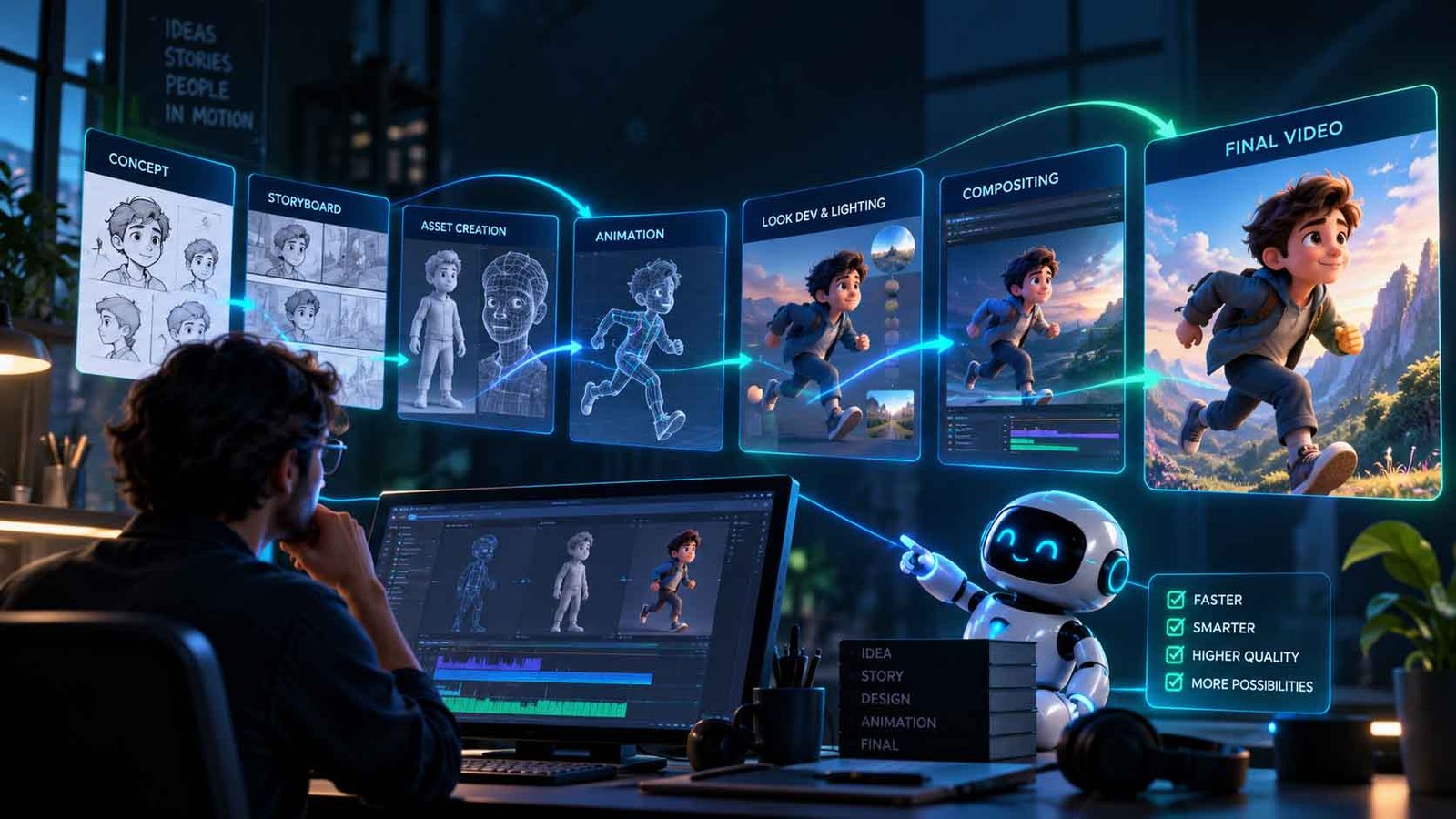
AI removes labour from four stages of animation production: concept exploration, asset generation, rough motion, and cleanup passes such as rotoscoping and upscaling. It does not replace scriptwriting, storyboard logic, art direction or final timing, because those stages decide what the video means rather than what it looks like.
Key facts
- Stages AI genuinely compresses: concept art, background and asset generation, rough in-betweens, rotoscoping, upscaling
- Stages AI does not compress: script, storyboard logic, art direction, timing, sound design, client revision rounds
- Where the hidden cost appears: selection and correction time, which grows with the number of generated options
- Turnaround at Lucid Motion Studio: 1 to 2 weeks for AI-powered video against 4 to 8 weeks for traditional 2D
- What never changes: a video that fails without its voice-over has a script problem, not a tooling problem
On this page
The question worth asking
Most conversations about AI in animation argue about whether the output is good enough. That is the wrong axis. Animation is not one job, it is roughly a dozen jobs arranged in sequence, and AI has landed on some of them hard and barely touched others.
The useful question is narrower: which stage of the pipeline are we talking about? Answer that and the cost and schedule implications follow. Skip it and you get the usual argument, where one side points at an impressive generated clip and the other points at a client revision that no model can execute.
Where AI removes real work
Four stages have genuinely changed.
Concept exploration. Producing twenty visual directions for a client used to mean a day of illustration for perhaps three options. Generated concepts turn that into an afternoon, and the client sees breadth instead of a single bet. This is the least controversial win in the whole pipeline, because concept art is throwaway by design.
Asset and background generation. Environments, props, textures and one-off background elements are now faster to generate and correct than to draw from zero. The saving is largest on projects with many unique locations and smallest on projects that reuse one set.
Rough motion and in-betweens. The mechanical middle of 2D animation, getting from one keyframe to the next, is where the labour has always been. This is the stage with the biggest theoretical saving and the most variable real-world one.
Cleanup passes. Rotoscoping, matte extraction, upscaling and frame interpolation are now routine automated steps. Nobody misses doing them by hand.
Where the work stays exactly where it was
| Stage | Why AI does not compress it |
|---|---|
| Script | It depends on knowing the buyer's real objection, the legal constraint, and what the sales team already says. None of that is in the model. |
| Storyboard logic | Deciding what a shot is for is a narrative judgement. A model can draw the shot; it cannot tell you the shot is redundant. |
| Art direction | Consistency across sixty shots is a decision problem, not a rendering problem. |
| Timing | Comic timing and emphasis live in frames, not prompts. |
| Sound design | Still the cheapest way to raise perceived quality, and still hand-made. |
| Client revisions | "Make her look more confident" is a direction, and directions need a director. |
The pattern is consistent: AI compresses the stages that decide how a video looks, and leaves untouched the stages that decide what it means.
The cost nobody quotes
Generation is cheap. Selection is not.
When a stage produces three options, a human reviews three options. When it produces three hundred, someone still reviews them, and that review is now the bottleneck. Teams that report no time saving from AI have almost always moved the labour rather than removed it: less drawing, far more looking.
Two habits keep this under control. Lock the style before generating anything, so that the generated set is narrow instead of wide. And cap the number of options per shot before the work starts, because an uncapped option count expands to fill whatever time is available.
How this changes what you should commission
If you are buying video in 2026, the practical implications are small in number.
- Ask which stages of the pipeline are AI-assisted. A studio that cannot
answer that precisely has not thought about it.
- Judge the script separately from the visuals. A generated look cannot rescue
a script that does not know what it is arguing.
- Expect AI-powered work to be quoted and scheduled differently. We deliver
AI-powered video in 1 to 2 weeks against 4 to 8 for traditional 2D, and it sits at the lower end of our price range.
- Match the format to the stakes. Campaign and social volume is where the
speed advantage compounds. A flagship brand film is usually not.
The test that still works
The oldest quality test in animation has not changed and is not affected by any of this. Mute the video and show it to someone who knows nothing about the product. If they cannot follow what is happening, the problem is in the script or the storyboard, and no amount of generation quality will fix it.
That test is why the stages AI has not touched are the ones that still decide whether a video works. The tooling changed. The judgement did not.
If you want a format recommendation for a specific brief, the 2D vs 3D vs AI comparison walks through the decision, or send us the brief and we will reply with a fixed price and a recommended format within 24 hours.