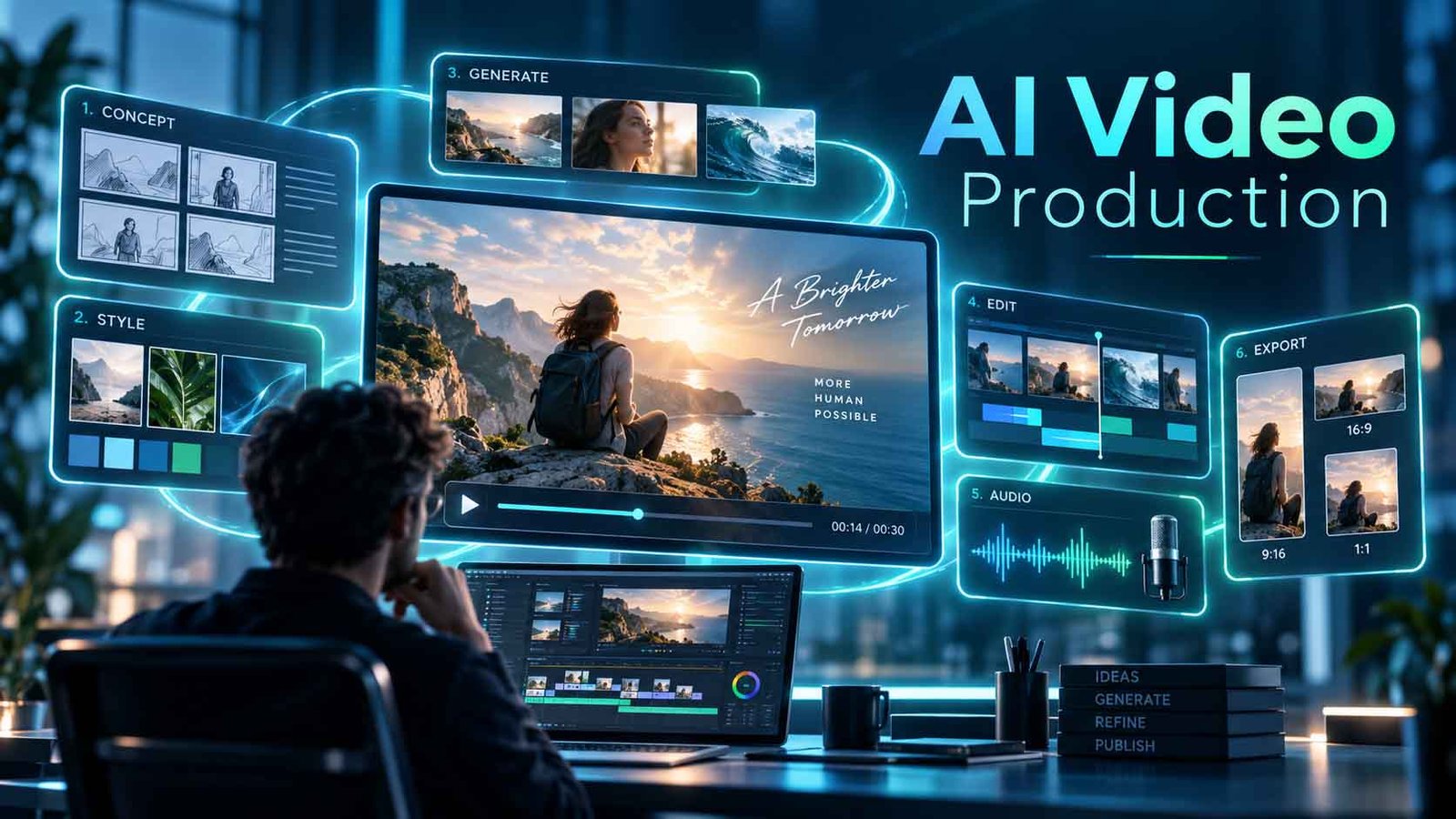
AI video production uses generative models for image, motion and voice inside a directed pipeline, with a human writing the script, setting the style and approving every shot. At Lucid Motion Studio it delivers a 60-second brand video in one to two weeks from $180, against four to eight weeks for traditional 2D. It suits campaigns, social and volume, and is a poor fit for exact interface accuracy and strict brand systems.
Key facts
- Typical turnaround: 1 to 2 weeks for a 60-second AI-powered video, against 4 to 8 weeks for traditional 2D and 8 to 12 for 3D
- Lucid Motion Studio pricing: from $180 for up to 30 seconds, from $340 for 60 to 90 seconds, script and sound design included
- What stays human: script, storyboard logic, art direction, timing, sound design, client revisions
- Best fit: ad campaigns, social volume, concept testing, market variants of an existing video
- Worst fit: exact UI reproduction, strict brand identity systems, licensed characters, anything needing frame-level control
- The real bottleneck: selection and correction time, which grows with the number of generated options
On this page
What people mean by AI video production
The phrase covers three quite different things, and quotes for them differ by a factor of twenty.
At one end is a template tool: you type a prompt or paste a blog post and a product assembles stock footage and a synthetic voice. At the other end is a traditional animation studio using generative tools inside an otherwise normal production, with a writer, an art director and an editor still in the chairs. In the middle sits prompt-only generation, where somebody writes a series of prompts and stitches the clips together.
What a business buys under the words "AI video production company" is usually the third thing and usually wants the second. The gap between them is where most disappointment lives.
At Lucid Motion Studio the AI-powered pipeline is the second kind: the same five stages as every other project, with generation replacing drawing at the asset and motion stages. Discover, script, storyboard, animate, deliver.
What the pipeline actually looks like
| Stage | Who does it | What changed with AI |
|---|---|---|
| Brief and discovery | Human | Nothing |
| Script | Human | Nothing. A model drafts; a person decides |
| Style lock | Human, with generated options | Faster to explore, same decision |
| Storyboard | Human | Frames come faster, the logic is unchanged |
| Asset and shot generation | Generative models, directed | This is the saving |
| Selection and correction | Human | This is the new work |
| Timing and edit | Human | Nothing |
| Voice, music, sound design | Mixed | Synthetic voice is now viable for many uses |
| Revisions | Human | Harder, not easier |
The last row is the one to read twice. In traditional 2D, "make the chart appear one second later" is a small, certain edit. In a generated pipeline, changing one element can mean regenerating a shot and re-selecting, which is why a disciplined studio locks the style before generating anything rather than after.
The five things it is genuinely good at
Campaign and ad creative at volume. Six variants of one concept for testing, rather than one variant you hope is right.
Social output on a weekly rhythm. The format where speed compounds and where nobody is examining frame 43.
Concept testing before committing. Producing a rough version of three directions costs less than producing one finished piece the old way, so the expensive decision gets made with evidence.
Market and language variants. A video that already exists, reissued for another market, is one of the cleanest uses there is.
Anything where the alternative was nothing. Most businesses do not have a choice between an AI video and a $12,000 agency film. They have a choice between an AI video and no video.
The four places it still fails
Exact interface reproduction. If a prospect has to see your real product UI, generated approximations of it are worse than useless, because the thing they are shown is not the thing they will get. That is a job for SaaS product video built on real screens.
Strict brand systems. A locked identity with defined typography, spacing and illustration rules will be approached, not met, and the correction work can cost more than drawing it.
Licensed or established characters. Consistency across a series is the weakest point of generative pipelines and the strongest requirement of character work.
Anything needing frame-level precision. Comic timing, a specific gesture on a specific beat, a diagram building in an exact order.
There is also a fifth, quieter one: the option-count trap. Generation is cheap and selection is not. A team that produces three hundred options still has to look at three hundred options, and teams that report no time saving from AI have usually moved the labour rather than removed it. Capping options per shot before work starts is the fix.
What it costs
Market prices for AI-assisted video sit below custom traditional animation, generally under $1,000 for short-form work. Lucid Motion Studio does not price AI-powered video differently from anything else: fixed packages from $180 for up to 30 seconds and $340 for 60 to 90 seconds, with script, storyboard, voiceover, music, sound design and delivery in every format included. For teams producing continuously, subscription plans start at $1,999 per month.
Two structural reasons the number can sit where it does: an AI-assisted pipeline for the formats where it does not compromise the result, and a Dubai cost base rather than a London or New York one.
Illustrative scenario, not a specific client. A B2B software company has a funding announcement in three weeks and needs a 45-second brand video plus six social cutdowns. Traditional 2D cannot start and finish in three weeks at that volume. The AI-powered route locks a style frame in two days, scripts in three, generates and selects over four, and leaves a week for revisions and the cutdowns. The trade-off they accept: the video approaches the brand palette rather than matching it exactly, which matters less for a launch announcement than missing the date would.
How to brief an AI video production company
Ask four questions before you commission anything.
- Which stages are AI-assisted? A studio that cannot answer precisely has
not thought about it.
- How is style consistency held across shots? The answer should describe a
reference set built before generation, not a prompting technique.
- What happens when I ask for a change at revision two? This is where the
difference between pipelines shows up in your calendar.
- Who writes the script? If the answer is a model, expect a competent,
generic video. The script is what makes it yours.
Where it sits against the other formats
AI-powered video is one of several options, not a replacement for the others. The short version: 2D for ideas, processes and software; 3D when the physical object is the story; AI-powered when speed and volume matter more than frame-level control. The full comparison of 2D, 3D and AI-powered animation walks through the decision properly, and what AI actually replaces in the pipeline covers the stage-by-stage detail.
Send the brief and we will reply with a fixed price and a recommended format within 24 hours. Everything is handled over email and no call is required.