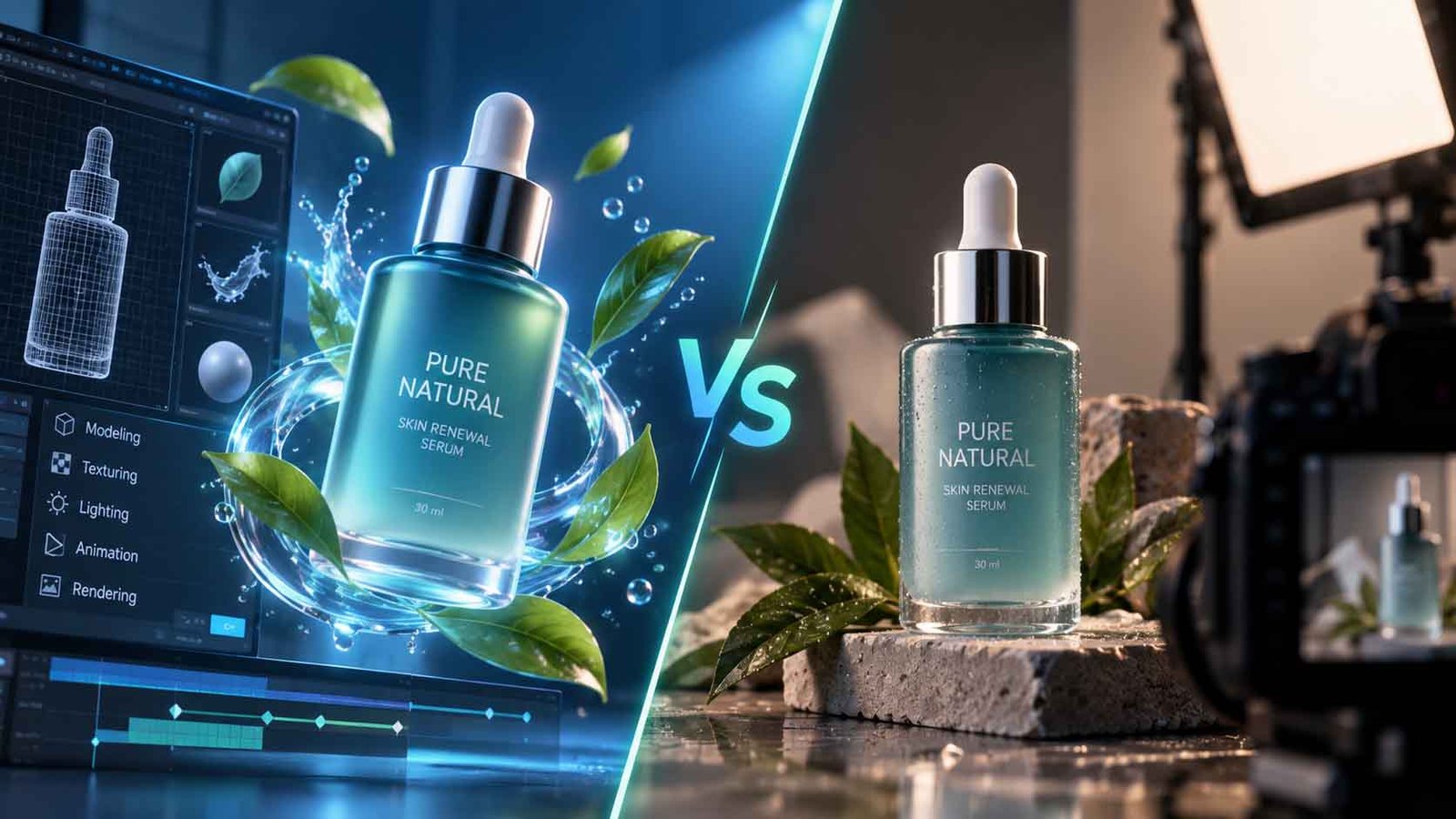
3D product animation wins when the product does not exist yet, when the selling point is inside the object, when many variants are needed, or when the shot is physically impossible. Photography and live action win when material realism, human scale or genuine context carry the message, and when the product is simple, available and photographs well. Many brands need both, used for different jobs.
Key facts
- 3D wins: pre-production products, internal mechanisms, cutaways, many variants, impossible camera moves, industrial scale
- Photography wins: real materials judged by touch, simple products, human context, and speed when the object is on hand
- The variant test: past roughly six to eight colourways or configurations, 3D usually becomes cheaper per asset
- The reuse test: 3D assets are reusable across video, stills, web and AR. A photo shoot produces photographs
- Cost order: photography is cheapest to start, 3D is cheapest to repeat
- Timeline: 8 to 12 weeks for 3D against days for a shoot, which decides more briefs than cost does
On this page
The question is not which looks better
Both can look superb. The decision is almost never about achievable quality, and framing it that way leads brands to spend on 3D where a camera would have been faster, or to keep rephotographing a catalogue that should have been modelled two years ago.
The useful frame: what does this shot need to be true?
If it needs to be true that a real object sat in real light, photograph it. If it needs to be true that the viewer can see inside the object, watch it assemble, or see a version that does not exist yet, only 3D can do that.
Where 3D clearly wins
The product does not exist yet. Pre-launch campaigns, crowdfunding pages, trade show loops and investor material routinely need footage of something still in engineering. There is no camera solution to this.
The selling point is inside. Cutaways, exploded views, flow through a mechanism, a filter doing its job. A camera cannot be inside a sealed object, and cutting one open produces a prop rather than a product.
Scale is impossible or expensive. Industrial plant, machinery in situ, anything that would require shutting down a line or hiring a crane. Modelling the facility is often cheaper than filming in it.
Many variants. Twelve colourways, four configurations, three market versions. Changing a material on an existing model is close to free. Every additional photograph is another setup.
Impossible camera moves. Through a component, around an object at a speed no rig achieves, or a continuous move from macro to wide.
The asset outlives the video. One model feeds video, stills at any angle, a web configurator, AR and print. This is frequently what tips an ecommerce business over, rather than the video itself.
Where photography and live action win
Materials judged by feel. Textiles, leather, food, cosmetics on skin. These are the categories where photorealism is hardest and where audiences are most sensitive to anything that looks idealised. A render that is nearly right reads as wrong.
Human context. Someone using the product, hands for scale, a real space. A filmed person beats a modelled one, and the gap is obvious to viewers even when they cannot articulate why.
Simple products that photograph well. If the object is on a shelf, looks like itself and has no interior story, a shoot is faster and cheaper.
Speed. This decides more briefs than cost does. A shoot can happen next week. 3D takes eight to twelve weeks. If the deadline is short and the product is in the building, photograph it.
Authenticity as the message. Some categories sell on being real and unpolished. A perfect render actively works against that.
Side by side
| 3D animation | Photography | Live action video | |
|---|---|---|---|
| Product must exist | No | Yes | Yes |
| Interior and mechanism | Yes | No | Only if cut open |
| Cost of first asset | Highest | Lowest | Middle to high |
| Cost of twelfth variant | Very low | Same as first | Same as first |
| Time to first asset | 8 to 12 weeks | Days | Weeks |
| Material realism | Excellent, at cost | Perfect by definition | Perfect by definition |
| Human presence | Weak | Strong | Strongest |
| Reuse beyond video | Very high | Low | Low |
| Changes after delivery | Cheap | Requires reshoot | Requires reshoot |
Illustrative scenario, not a specific client. An ecommerce furniture brand sells one chair in nine fabrics and three frame finishes, which is 27 combinations. Photographing all of them means building the same set 27 times. Modelling the chair once and rendering the combinations costs more than the first photograph and far less than the 27th, and it produces stills, a short product video and a configurator from the same asset. They still book a photographer for the lifestyle set, because a real living room with real light and a real person in it does something no render does, and because fabric is exactly the material where buyers notice idealisation.
That mixed answer is the common one. Most brands do not choose. They allocate.
The two tests that resolve most briefs
The variant test. Count the versions you will need over the next two years, including colourways, configurations and market variants. Past roughly six to eight, the economics tilt toward 3D, because you are paying a setup cost once instead of a shoot cost repeatedly.
The reuse test. List everything the asset has to feed: video, web stills, print, a configurator, AR, trade show screens, sales decks. The longer the list, the stronger the case for a model, because a model answers all of them and a photograph answers one.
If both tests come back small, and the product exists, and the deadline is close, photograph it. That is a real answer and it is often the right one.
Where AI fits, and where it does not
Generative video is genuinely useful for the world around a product: an environment, a mood, a season, a place. It is not reliable for the product itself, because it produces something that resembles your object rather than your object.
The combination that works in practice is a real product photograph or an accurate 3D render composited into a generated environment. The thing being sold is exactly right; the world around it is cheap. That approach is covered in AI video ads.
What does not work is asking a model to generate your specific product. Close is not a standard that survives a customer comparing the ad to the box.
Cost and next steps
3D is quoted individually rather than from a fixed package, because modelling state, materials and variant count move the number much more than length does. What actually drives a 3D quote breaks those variables down, and the 3D animation page covers the formats the studio produces.
Send us the product, whether CAD exists, and the list of assets it has to feed. We will tell you honestly whether 3D is the right spend and return a fixed price within 24 hours, over email.