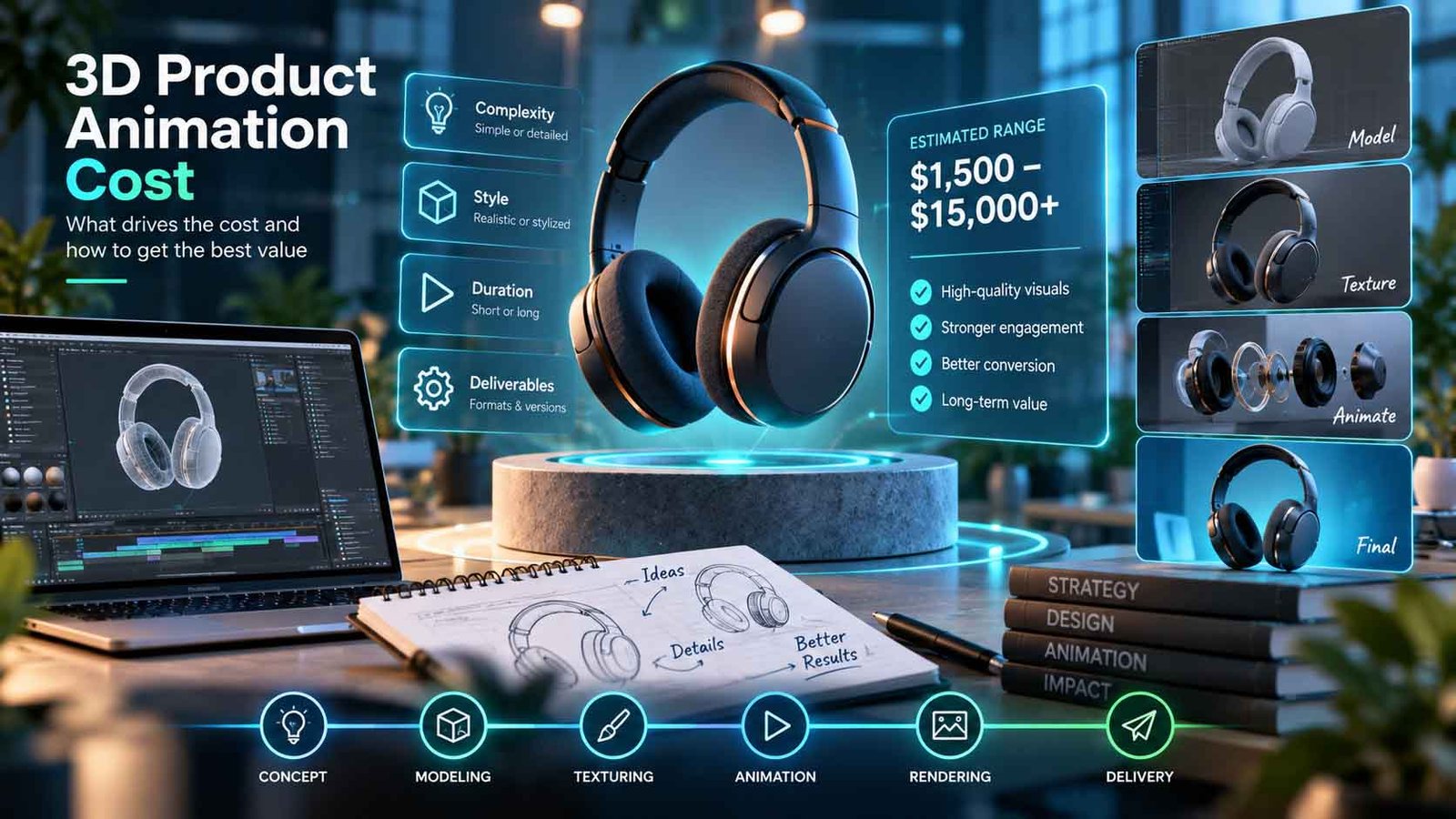
Custom 3D product animation generally starts around $10,000 per finished minute in 2026, with broadcast-quality work exceeding $50,000 per minute. Short 15 to 30 second product films sit well below that, and the single largest variable is not length but whether usable CAD exists. Modelling, texturing, lighting and rendering all happen before a frame of animation, and that setup is what separates 3D pricing from 2D.
Key facts
- Custom 3D, market rate: from around $10,000 per finished minute; broadcast work can exceed $50,000
- 2D comparison: $2,500 to $10,000 per finished minute, with no modelling phase at all
- Biggest single variable: whether clean, animation-ready CAD exists, or the object must be modelled from photographs
- Setup dominates: modelling, texturing, rigging, lighting and look development happen before any animation
- Production time: 8 to 12 weeks for 3D, against 4 to 8 weeks for 2D
- Lucid Motion Studio: 3D is quoted individually under the Premium tier rather than from a fixed package
On this page
Why 3D is priced differently from everything else
In 2D animation, the cost is roughly the drawing and the moving. In 3D, most of the cost happens before anything moves.
An object has to be modelled. The model has to be given materials that behave like the real ones under light. The scene has to be lit. Then it has to be rendered, which consumes machine time that no amount of extra staff shortens. Only after all of that does animation begin.
This is why 3D quotes seem to ignore length. Producing ten seconds and producing forty seconds share almost all of that setup, so the second thirty seconds costs far less than the first ten. It is also why "how much for a 30-second 3D video" has no useful answer without knowing what is being modelled.
The market numbers
| Format | Typical 2026 range, per finished minute |
|---|---|
| Template and AI-assisted video | Under $1,000 |
| 2D animation and motion graphics | $2,500 to $10,000 |
| Custom 3D product animation | From around $10,000 |
| Broadcast and high-end commercial 3D | $50,000 and above |
For context on the wider market, the full breakdown of animation costs by tier and style covers where those bands come from and what each buys.
The six things that move a 3D quote
1. Whether usable CAD exists. This is the big one. If you have clean, animation-ready geometry, the modelling phase largely disappears. If the product exists only as photographs, it must be modelled from reference, and that is skilled work measured in days per object.
A caution that surprises people: engineering CAD is not automatically usable. Manufacturing files often contain internal components, fasteners and tolerance data that are invisible in a render and expensive to strip out. Clean is not the same as detailed.
2. Material complexity. Matte plastic is cheap. Brushed metal, clear glass, liquid, fabric, skin and anything translucent are not, because they interact with light in ways that require both artistry and render time.
3. Photorealism versus stylisation. Photorealism is judged against reality, so every imperfection registers. A stylised look sets its own rules and is correspondingly more forgiving. If the exact finish is not the point, stylisation often buys a better-looking video for less.
4. Mechanism and motion. A static product turning on a pedestal is one thing. An exploded view that reassembles, a mechanism that operates, or an assembly sequence each require rigging and a correct understanding of how the object actually works.
5. Environment. A product on a clean studio background is far cheaper than a product in a full environment, because the environment is a second modelling and lighting job.
6. Number of products and variants. Once one object is modelled and lit, colourways and configurations are comparatively cheap. A catalogue of twelve products is not twelve times one product, but it is not one either.
Illustrative scenario, not a specific client. An industrial manufacturer wants a 40-second animation of a pump, including a cutaway showing internal flow. Their engineering CAD exists but carries every fastener and internal tolerance. Two paths: clean the existing CAD, which is a few days of unglamorous work but yields a dimensionally exact model, or rebuild a simplified visual model from drawings, which is faster but must be checked against engineering for accuracy. They choose cleaning, because the cutaway is the whole point and an approximated internal geometry would be worse than no cutaway at all. Twelve colour and configuration variants are then produced at a small fraction of the original cost, because the expensive work is done.
Where the savings actually are
- Supply clean CAD, or budget for the modelling honestly rather than
discovering it mid-project.
- Commission variants at the same time. Extra colourways, configurations
and market versions are cheap once the setup exists and expensive as a separate project later.
- Choose stylised if the exact material finish is not the selling point.
- Use a studio background unless the environment is part of the story.
- Shorten before you simplify. Cutting fifteen seconds of a well-made
animation costs less quality than cutting the lighting budget.
- Mix formats. 3D for the product hero, 2D or motion graphics for the
explanation around it. Many of the best product videos are not 3D throughout.
What does not save money: cutting revision rounds. It saves the least and costs the most in frustration, and in 3D a late change can mean re-rendering.
Timeline
Eight to twelve weeks for a typical 3D project, against four to eight for 2D and one to two for AI-powered video. The stage-by-stage production timelines article breaks that down.
The front of the schedule is modelling and look development, and it is the part clients most often underestimate. Approving a look early is worth more to the delivery date than anything else you can do.
What Lucid Motion Studio charges
3D sits in the Premium tier and is quoted individually rather than from a fixed package, because the variables above move the number far more than length does. Product visualisation, exploded views, cutaways, architectural and industrial animation are all covered on the 3D animation page.
What is included in every quote regardless of tier: script, storyboard, design, animation, voiceover, music, sound design, a stated number of revision rounds, and delivery in every format you need. If any of those appear as separate line items on a quote you are comparing, the headline number is not the real number.
Before commissioning, it is worth checking that 3D is the right tool at all. 3D product animation against photography and live action covers when each one wins.
Send us the product, the CAD situation and what the video has to prove, and we will return a fixed price within 24 hours, over email.