How to choose an animation studio: 10 questions to ask before hiring
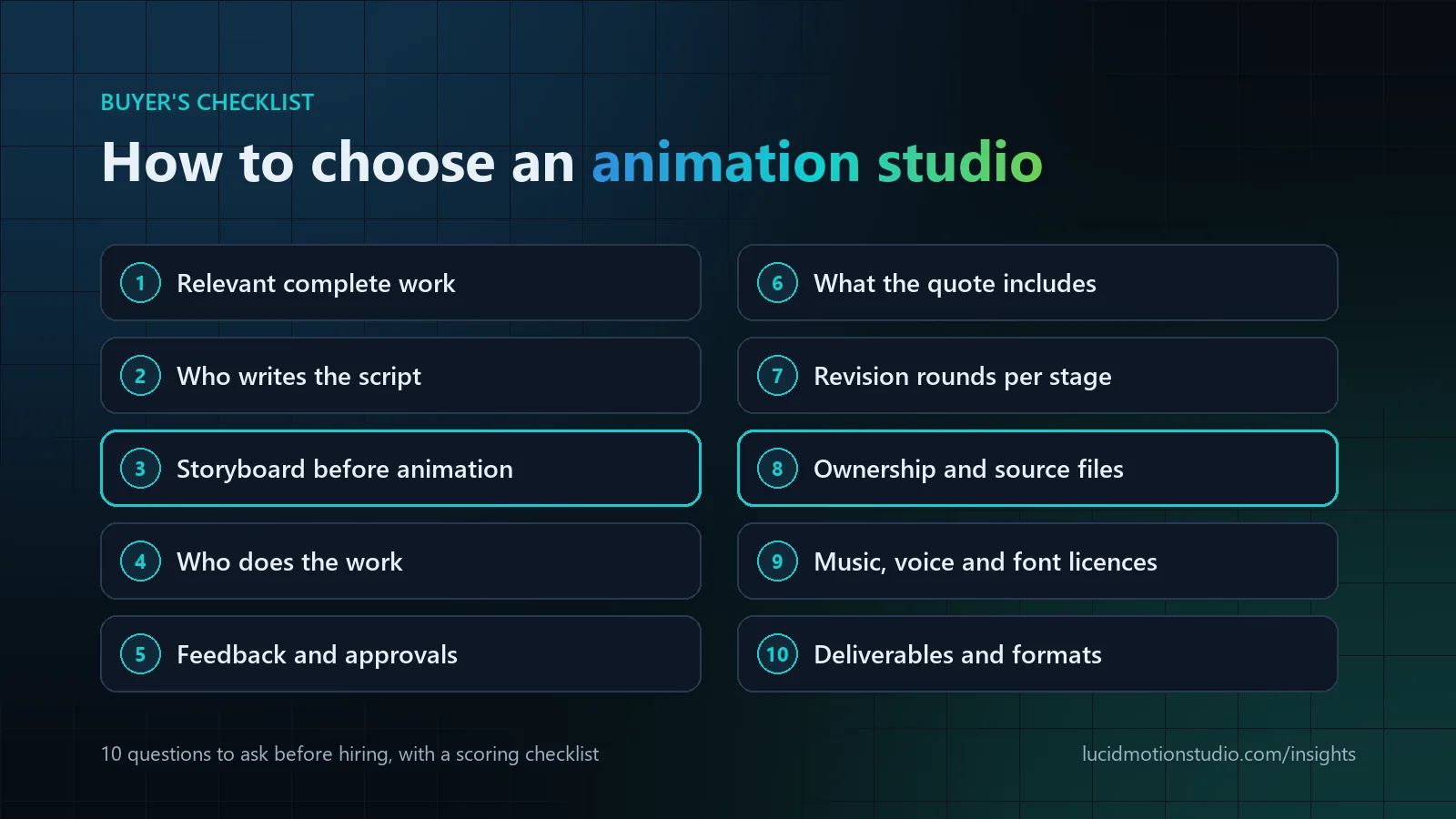
Choose an animation studio on evidence you can check rather than on its showreel. Ask for complete films in your format, a written process with script and storyboard approval before animation, the names of the people who will do the work, a scoped quote with stated revision rounds, and clear written terms on ownership, licences and source files. Compare price only after those match, because two quotes with the same total often describe different projects.
Key facts
- Send every studio the same brief. Otherwise you compare three different projects, not three studios
- Judge complete films, not reels. Ask what the studio did on each one: script, design, animation or all of it
- Approval gates protect the budget. Script, storyboard and style frames should be signed off before animation
- Ownership must be in writing. Paying for a video does not automatically transfer every right in it
- Source files and licences are separate questions. Ask before signing, not after delivery
- Use the scoring checklist at the end of this guide to compare proposals on evidence
Start with your own brief, not the studio's showreel
Most studio comparisons go wrong before the first call. Each studio hears a slightly different version of the project, quotes against its own assumptions, and the buyer ends up comparing three different jobs. Before you contact anyone, write half a page that every studio receives unchanged:
- The job the video must do. Explain a new product, shorten sales calls, train staff or support a launch.
- Who watches it, and where. Homepage visitors, procurement teams, new employees or paid social audiences.
- Length and versions. A rough running time, plus the cutdowns, aspect ratios and languages you already know you need.
- A budget range and a date. Studios propose very different approaches for a small budget and a large one, so a range saves everyone time.
- Who approves. The person who signs off the script, and anyone else with a veto.
With a fixed brief, the differences between answers tell you how each studio thinks. If this is your first commission, read our guides to what an animated explainer costs and how long animation production takes to set a realistic range first.
The 10 questions to ask an animation studio before hiring
Each question below comes with what a strong answer usually sounds like. A studio does not need to answer in these exact words, but it should answer specifically. Vague answers at the sales stage tend to become vague processes later.
1. Can you show finished work like ours, and what exactly did you do on it?
Showreels are edited to hide weaknesses: two-second fragments of the best shots, cut to music. Ask for two or three complete films in the format you need, such as a 90-second SaaS explainer, a 3D product film or a training module, ideally from a comparable industry. Then ask what the studio's role was. Did it write the script, design the characters, animate, record the voice, or only animate someone else's storyboard?
A strong answer names the stages it handled and the ones the client or another supplier did. A weak answer claims every frame of every reel without detail, or cannot show any complete film because "everything is under NDA". Confidentiality is real and common, but an established studio can usually show some finished work in your format.
2. Who writes the script, and how do you turn our material into one?
The script decides more about the result than the animation style does. A 60-second explainer carries roughly 130 to 160 spoken words, so every sentence has to earn its place. Ask who writes it, what they need from you (a product demo, a sales deck, the questions customers ask) and how many drafts are included.
A strong answer describes a discovery step and treats script approval as a formal gate. A weak answer is "send us your script", with no offer to adapt it for timing and visuals.
3. Will we approve a storyboard and style frames before animation starts?
Changes get more expensive as production moves forward. Rewording a line in the script takes minutes; changing it after animation can mean re-timing scenes and re-recording the voice. Serious studios therefore put approval gates at script, storyboard and design, so the expensive stage only starts once the cheaper stages are settled.
A strong answer includes an example storyboard and style frame from a past project. A warning sign is a studio that goes straight from brief to "first draft of the animation".
4. Who will actually work on our project?
Studios range from a single founder with a freelance network to large in-house teams. Neither model is wrong, but you should know which one you are buying. Ask who your day-to-day contact is, whether the writer, designer and animator are employees or contractors, and whether any part of the work goes to another studio.
A strong answer names a producer or project manager and explains how the team is put together for your project. A warning sign is discovering after signing that the work has passed to a supplier you never met.
5. How do you handle communication, feedback and approvals?
Ask how previews are shared, how comments are collected and how quickly the studio usually replies. Time zones matter on international projects, but a studio several hours ahead or behind can still be fast if feedback windows are agreed in advance.
Agree your own side too. Scattered feedback from several reviewers is one of the most common causes of delay, so nominate one person to consolidate comments for each round.
6. What exactly does the quote include?
Two quotes with the same total can describe very different projects. Ask for the scope in writing: running time, style, number of scenes or characters, voiceover, licensed music, sound design, captions, cutdowns, aspect ratios and language versions. Our list of what a complete animation quote includes is a useful reference when you compare line by line.
7. How many revision rounds are included, at which stages, and what does an extra round cost?
"Unlimited revisions" sounds generous but usually comes with limits on what counts as a revision. A clearer arrangement states the rounds at each stage (script, storyboard, animation), the price of an extra round, and how changes to an already approved stage are handled.
A strong answer points to written terms. At Lucid Motion Studio, for example, each package states its revision rounds at script, storyboard and animation, and substantial changes requested after animation has begun are quoted and approved before any extra cost is incurred.
8. Who owns the finished video, and do we get the source files?
Do not assume that paying for a video means owning every right in it. Under United States copyright law, for example, a specially commissioned work only counts as a "work made for hire" if it falls into one of the listed categories (part of an audiovisual work is one) and both parties expressly agree to it in a signed written instrument. Other countries handle commissioned work differently. The practical rule is the same everywhere: get the transfer of rights, or the licence you receive, in writing.
Source files are a separate question. Project files from tools such as After Effects, Blender or Cinema 4D are often excluded unless requested, and they matter if your in-house team or another supplier will edit the video later. Ask whether they are included, whether they cost extra, and whether the fonts, music and stock inside them can be passed on.
9. What licences come with the music, voice, fonts and stock assets?
The video can be yours while some of its ingredients are licensed for limited use. Music libraries, voice artists and stock footage often license by media (web, broadcast, paid advertising), territory and term, so a voice recorded for a website explainer may need an extended licence before it runs as a broadcast ad. Typefaces used in video may need a licence that covers it. If AI tools generated any images, motion or voice, ask which tools were used and what their terms allow commercially.
A strong answer lists the licence for each type of asset and flags any usage limits before production, not after delivery.
10. What will we receive at the end, and in which formats?
Agree the delivery list at the quote stage: the master file and its resolution, aspect ratios (16:9, 9:16, 1:1), cutdowns for ads, a silent captioned version, subtitle files such as SRT, voiceover language versions, still frames for thumbnails, and project files where agreed. Versions planned from the start cost far less than versions requested after the master is finished, because layouts and text layers can be built for them.
How to compare animation studio proposals side by side
When proposals arrive, put them in one table before you look at the price. Then normalise them: if one studio quoted 60 seconds with library music and another 90 seconds with custom sound design, you are comparing different products.
| Criterion | What to look for | Warning sign |
|---|---|---|
| Scope | Running time, style, scenes, voice, music and versions stated | "Explainer video" with no detail |
| Process | Script, storyboard and design approved before animation | Animation starts straight from the brief |
| Revisions | Rounds per stage and the cost of an extra round, in writing | "Unlimited" with no definition |
| Timeline | Dates for each stage, including your review windows | One delivery date and nothing in between |
| Team | A named contact and a clear account of who does the work | Unexplained subcontracting |
| Rights | Transfer or licence of the final video, in writing | Silence on ownership |
| Source files | Stated as included, priced or excluded | Discovered only when you ask a year later |
| Licences | Music, voice, fonts, stock and AI terms listed | "Royalty-free" with no usage scope |
| Relevant work | Complete films in your format | Reel fragments only |
The timeline is also a useful honesty test. As a reference point from our own schedules, a 60-second 2D or motion graphics video typically takes two to four weeks from brief to delivery, and detailed 3D work usually takes four to eight weeks. A proposal far below that needs an explanation, such as an existing visual style or a template, and one far above it may simply reflect a queue.
How to judge animation quality when you are not an animator
You do not need production training to tell good animation from average. Watch three complete films from a studio's portfolio and check:
- Is the message clear with the sound off? Much social video starts muted. Strong animation carries the story visually, with on-screen text where it matters.
- Does on-screen text stay up long enough to read? Read each caption aloud at a normal pace. If it disappears first, the studio is timing for looks rather than understanding.
- Does movement feel deliberate? Good motion eases in and out and settles. Weak motion slides at constant speed or moves without a reason.
- Is the design consistent? Characters, line weights, colours and icon styles should stay the same from the first scene to the last.
- Is the audio clean? The voice should sit clearly above the music, without level jumps between lines.
- Could you summarise the film in one sentence? If not, the problem is the script, and the studio's writing process matters more than its animators.
Warning signs when hiring an animation studio
- No complete films, only reels, and no explanation why.
- A fixed price before anyone has asked about your audience or goal.
- No storyboard or style-frame stage before animation.
- Pressure to pay the full amount up front, when payments tied to milestones are common practice.
- Vague answers on ownership, licences or source files.
- Claims nobody can check, such as "the best studio in the world" or guaranteed results.
- A schedule with no time for your reviews.
Animation studio selection checklist
Score each studio 0, 1 or 2 on every line: 0 means no evidence, 1 means stated but not shown, 2 means shown or committed in writing. The total is not a formula for the decision, but it makes gaps visible and keeps the discussion on evidence rather than impressions.
| # | Criterion | Score (0 to 2) |
|---|---|---|
| 1 | Complete films in our format and a comparable industry | |
| 2 | A clear account of the studio's role on those films | |
| 3 | Scriptwriting or script adaptation included, with drafts stated | |
| 4 | Storyboard and style frames approved before animation | |
| 5 | A named contact and a clear team structure | |
| 6 | Feedback, review windows and approvals agreed | |
| 7 | Written scope: length, style, voice, music and versions | |
| 8 | Revision rounds per stage and the cost of extra rounds in writing | |
| 9 | Rights in the final video transferred or licensed in writing | |
| 10 | Source files and asset licences stated | |
| 11 | Delivery list agreed: formats, ratios, captions and languages | |
| 12 | A timeline with stage dates that matches the scope |
Twelve lines, 24 points. A studio that scores well below the others on rights, revisions or process is a risk at almost any price.
Extra questions if you are an agency
Agencies hiring a studio to produce under their own brand need everything above, plus confidentiality rules: no studio branding or credits, no contact with the end client, no portfolio use without permission, and no studio names left in file names or metadata. Those points, and how white-label pricing and margin work, are covered in how white-label animation works for agencies.
How Lucid Motion Studio answers these questions
We would rather be judged against this list than against a showreel. Our Work shows complete films grouped by format and industry. Scripts, storyboards and style frames are approved before animation, as set out on How It Works. Our fixed-price packages state the revision rounds. Rights in the final video transfer to the client on full payment, as our terms set out, and source files are available on request. Every quote arrives in writing within 24 hours, and we are happy to work under your NDA when confidentiality is required.
If you are comparing studios now, send us the same brief you are sending everyone else, or ask for a free sample: a short custom sample or storyboard in the style you choose, so you can judge the creative fit before any production budget is spent.
Sources
Related reading
Common questions
How many animation studios should we ask for a proposal?
Is the cheapest animation studio always the riskiest choice?
Should we hire a freelance animator or an animation studio?
What should we send an animation studio to get an accurate quote?
Comparing animation studios? Put us to the test.
Send the same brief you are sending everyone else. We will answer these ten questions in writing, recommend a format and return a fixed-price quote within 24 hours, or create a free sample so you can judge the creative fit first.