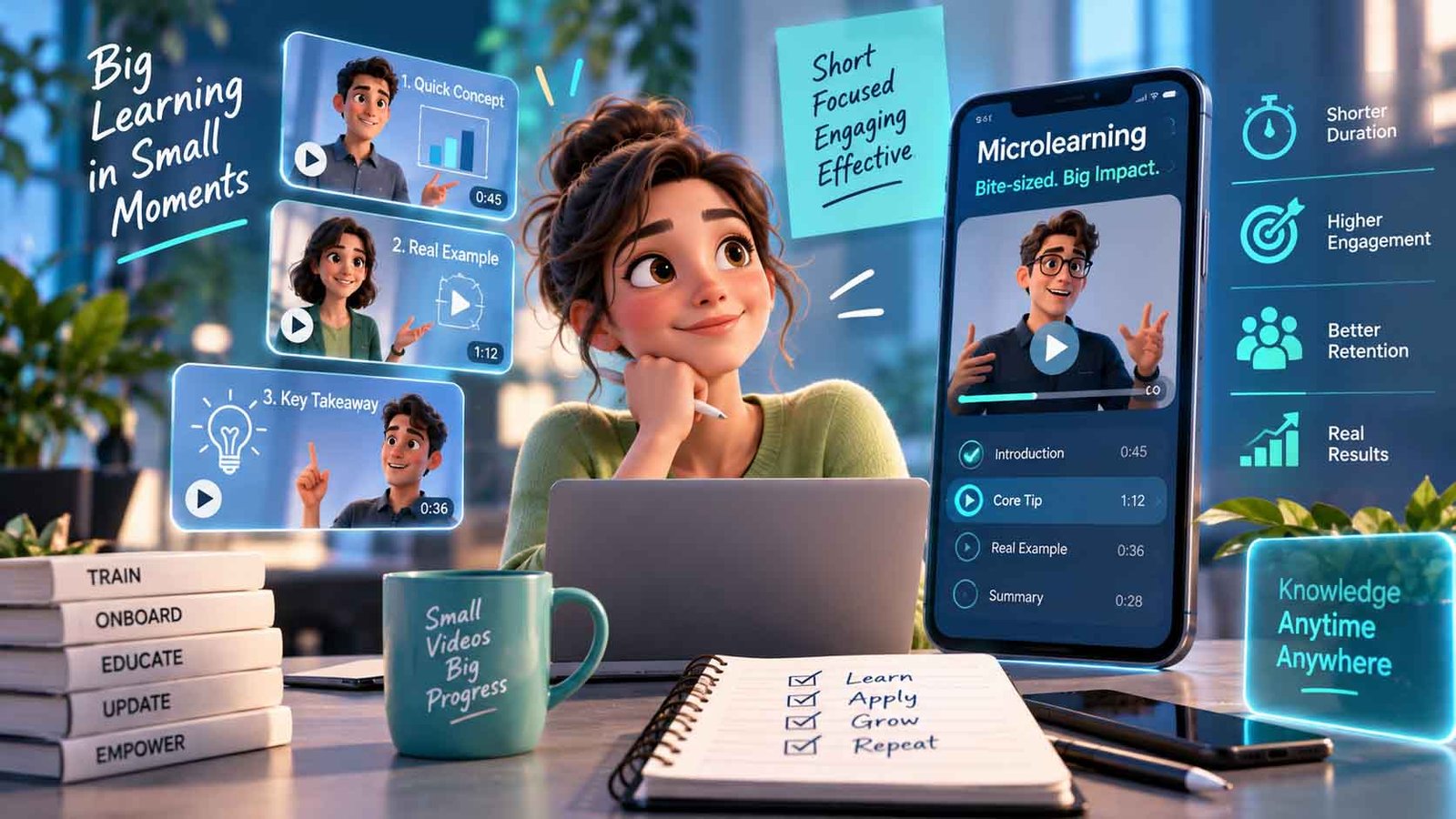
Microlearning video replaces a long course with short single-topic modules, typically three to five minutes, that a learner can find and watch at the moment they need them. It suits procedure, policy refreshers, software and compliance, because those are looked up rather than studied. It does not suit content that requires sustained reasoning across connected ideas.
Key facts
- Module length: 3 to 5 minutes, one topic, one learning point
- The real driver: findability. A 40-minute course cannot be searched at the moment of need
- Best fit: procedure, compliance refreshers, software, policy, onboarding steps
- Poor fit: anything needing sustained reasoning across connected concepts
- Production advantage: a shared style means each module after the first is much cheaper
- Maintenance advantage: a changed rule means re-rendering one module, not an annual course rebuild
On this page
The shift is about search, not attention spans
The usual explanation for shorter training is that attention spans have collapsed. That is a comfortable story and mostly wrong, given the same employees will watch a 40-minute technical talk about something they care about.
The real problem with a long course is that it cannot be searched.
Consider what actually happens. An employee learns a procedure in an annual course in March. In September they need to do it and cannot remember the third step. Their options are to scrub through a 40-minute video looking for two minutes, or to ask the person at the next desk. They ask the person at the next desk, every time, and the expensive library sits unused.
A three-minute module titled with the exact question is findable. That is the whole argument, and it is an information architecture argument rather than a pedagogical one.
What changes when a course becomes modules
| 40-minute course | 8 modules of 4 minutes | |
|---|---|---|
| When it is watched | Once, when assigned | When the question comes up |
| Findable | No | Yes, if titled as questions |
| Completion | Tracked, often padded | Per module, and genuinely voluntary |
| Updating a changed rule | Rebuild or add an awkward addendum | Re-render one module |
| Adding a new topic | Reopen the whole course | Add module nine |
| Reuse | Little | Onboarding, refreshers, in-app help, intranet |
The last row is where most of the unplanned value appears. Once modules exist as separate objects, they get used in places nobody budgeted for: a link in an onboarding checklist, an answer pasted into a support reply, a page on the intranet, a screen in a break room.
How to break an existing course apart
List the questions, not the sections. Go through the course and write down every question it actually answers. Not "Section 3: Reporting", but "Who do I tell if I think I have been phished?"
Group into single topics. One module answers one question completely. If a module needs the word "also" more than twice, it is two modules.
Discard ruthlessly. Most long courses contain material that is there because it was in the source deck rather than because anyone needs it. This exercise typically removes a quarter of the content, and nobody notices it has gone.
Title as the question. "How to report a suspected phishing email" is findable. "Module 3: Incident Response" is not. This single decision does more for usage than anything about the video itself.
Sequence, but do not chain. Offer an order for people doing the whole thing, and make sure each module stands alone for the person who arrives from a search box with one question.
Where the format stops working
Microlearning is not a universal improvement, and pretending otherwise leads to some genuinely bad training.
Content that requires sustained reasoning. If understanding idea four depends on holding ideas one to three in mind simultaneously, chopping it into modules breaks the argument. Some material genuinely needs thirty uninterrupted minutes.
First-time certification with regulatory requirements. Some frameworks specify duration or a single assessed completion. Check before redesigning, and confirm the position with whoever owns compliance rather than assuming.
Skill-building that needs practice. Video is not the intervention. Microlearning video around a practice exercise is fine; microlearning video instead of one is not.
Anything where the point is shared experience. A culture or safety message delivered to everyone at once does something a searchable library does not.
Illustrative scenario, not a specific client. An operations team has a 45-minute onboarding course with a high completion rate and near-zero rewatch. Breaking it apart produces nine modules of three to five minutes, each titled as a question. Total runtime falls to about 35 minutes because a quarter of the content turns out to be padding. Completion of the sequence stays similar; what changes is that seven of the nine modules are watched repeatedly by people who finished onboarding months ago, and two of them get linked from the internal help pages. The library stops being a compliance artefact and starts being a reference.
The production economics
Per minute, short modules cost more than long ones. Each needs its own opening, its own structure and its own ending, and those fixed elements do not shrink with runtime.
Total cost usually falls anyway, for two reasons. You produce less total footage once the padding is removed. And the style, characters and asset library are established once on the first module and reused across the rest, which is why a series is priced very differently from nine separate videos.
Maintenance is where the difference compounds. A changed rule in a long course means a rebuild or an addendum that sits awkwardly in the middle. In a modular library it means re-rendering one module, in whatever languages you run. Over a three-year library life, that usually outweighs the original production difference.
Build for it deliberately: one scene per section, volatile figures and system names kept out of the artwork, and scripts written for translation from the start. The detail is in the guide to commissioning animated training video.
What to specify when commissioning
- Module list with each one titled as the question it answers.
- Runtime target per module, and a hard cap.
- Languages needed now and likely within two years.
- Captions, transcripts, and the exact format your LMS requires.
- Sound-off versions with on-screen text, if any of the audience watches on a
shop floor or in a shared office.
- Which elements are expected to change, so those are isolated into their own
scenes.
Lucid Motion Studio produces modular training series in 2D and whiteboard styles with multi-language versions from one master, priced as a series rather than per video, because that is where the economics actually work.
Send us the course you want to break apart, or the material it would be built from, and we will come back with a module structure and a fixed price within 24 hours, over email.