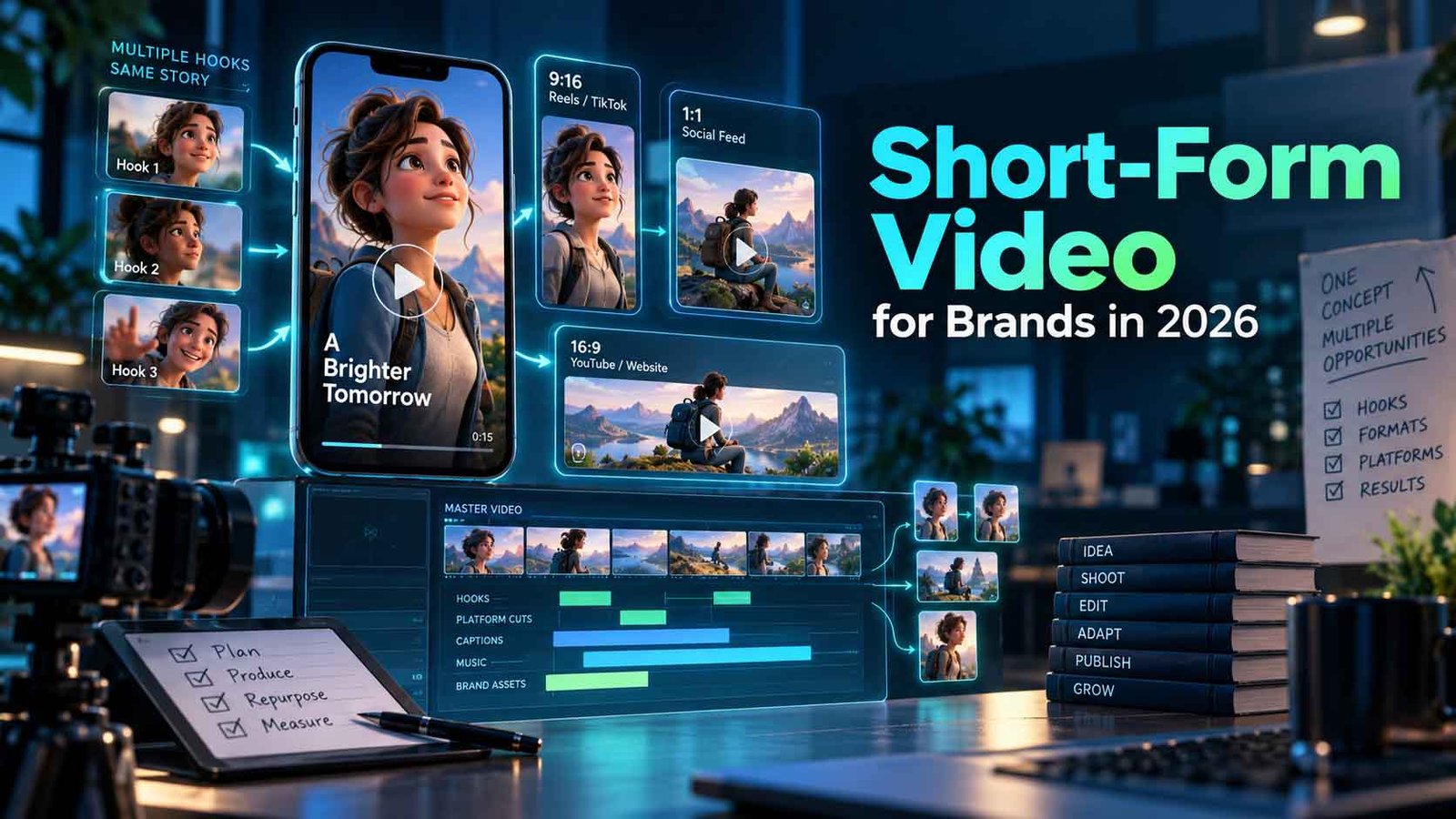
Brands should produce short-form video in sets rather than one at a time: one concept, several hooks, and platform-specific cuts from a single master. Reels and TikTok reward pace and native feel, LinkedIn rewards a clear point and works with sound off, and paid social lives or dies on the first two seconds. Animation suits this better than filming, because variants cost almost nothing once the assets exist.
Key facts
- Lengths: 6 to 15 seconds for paid social, 15 to 30 for organic Reels and TikTok, 30 to 60 for LinkedIn
- The hook decides: the first two seconds determine most of the performance, so test hooks rather than concepts
- Produce in sets: one concept, four to six hooks, two end cards, cut to 9:16, 1:1 and 16:9
- Sound off by default: on-screen text and legible motion, with audio as an enhancement
- Safe areas matter: platform interface covers the bottom fifth and the right edge of a vertical frame
- Why animation fits: variants are cheap once assets exist, where every filmed variant is another setup
On this page
Stop commissioning videos, start commissioning sets
The most expensive mistake in short-form is treating each post as a project.
A brand that needs twelve pieces of video a month and commissions twelve videos pays twelve setup costs, gets twelve slightly different looks, and learns nothing from any of them, because no two are comparable.
A brand that commissions two concepts, each with six openings and cut to three aspect ratios, pays two setup costs, ships roughly the same volume, looks consistent, and finds out which opening works.
That second shape is what short-form production should look like, and it is the main reason animation fits the format. Once a style, a character set and a type system exist, the marginal cost of another variant is small. Every filmed variant is another shoot.
What each platform actually wants
| Reels and TikTok | Paid social | ||
|---|---|---|---|
| Length | 15 to 30 seconds | 30 to 60 seconds | 6 to 15 seconds |
| Opening | Motion or hook in under 1 second | A clear claim or question | The hook is the whole ad |
| Register | Native, fast, informal | Considered, useful, specific | Direct |
| Sound | On for many viewers | Off for most | Off by default |
| Captions | Expected | Essential | Essential |
| What fails | Anything that looks like a TV ad | Anything without a point | Anything slow |
The useful summary: TikTok and Reels punish anything that announces itself as advertising, LinkedIn punishes anything without a substantive point, and paid social punishes anything that takes more than two seconds to become interesting.
The hook is the product
Performance in short-form is dominated by the first two seconds, and nothing reliably predicts which opening will work. This is why the format should be approached as a test rather than a production.
A practical set:
- One concept and one script spine.
- Four to six alternative openings. A question, a claim, a number, a
visual surprise, a problem statement, a direct address.
- Two or three end cards with different calls to action.
- Each cut to 9:16, 1:1 and 16:9 from the same master.
Around twenty deliverables, one production. Then let the platform decide which opening survives, and build the next set around what won.
What not to do: produce two hundred variants. Generation is cheap, selection is not, and a library nobody has time to review is a backlog rather than an asset.
The craft details that quietly decide performance
Design for sound off. Most viewers will never hear it. Every essential point needs to be legible on screen, and the motion needs to carry meaning without narration. If the video is incomprehensible muted, it is incomprehensible to most of its audience.
Respect the safe areas. Platform interface covers roughly the bottom fifth of a vertical frame and part of the right edge, and captions sit over the lower area. A call to action placed there is invisible. Check this at storyboard stage, not after delivery.
Cut on the beat, not the sentence. Short-form pacing comes from visual change rather than from narration. If nothing has moved in a second and a half, something is wrong.
Put the brand in the middle, not the end. A logo on the final frame is seen by the small fraction who finish. Brand presence has to exist throughout, in colour, type and character, rather than being appended.
Subtitles as a design element. Burned in, styled to the brand, timed to the beat. Auto-captions are legible; designed captions are part of the video.
Illustrative scenario, not a specific client. A B2B software brand wants weekly output across LinkedIn, Reels and paid social. Instead of four videos a month, they commission one animated concept per month with six openings, plus a small library of reusable character poses, transitions and lower thirds. Month one costs the most, because the library is being built. From month two the same budget produces roughly double the output, because assembly is reuse rather than production. The LinkedIn cuts run 45 seconds with a fuller point, the paid cuts run 8 seconds and change only in the opening, and everything is legible with the sound off.
Where AI-powered production fits
Short-form is where AI-assisted animation makes the most obvious sense, because it is the format where speed and volume matter most and where nobody is examining frame 43.
It works well for product-in-scene, atmosphere, stylised lifestyle and character-led pieces, provided a reference set is built before generation so every video in the set looks like the same brand. The detail is in AI video ads, and there is a separate honest discussion of the creator-style format in AI UGC ads, which carries disclosure obligations that plain animated short-form does not.
The place it does not fit is anywhere a real person, a real place or a genuine reaction is the message. Film those.
Building a sustainable rhythm
Short-form only works cumulatively. One excellent video does very little; three months of consistent presence does a great deal. That makes the production model more important than any single output.
Three things make the rhythm sustainable:
- A reusable asset library. Characters, transitions, lower thirds,
backgrounds, an end card. Built once, assembled weekly.
- A locked style. So that anything produced in month six still looks like
the brand from month one.
- A standing capacity rather than a project cycle. Briefing, quoting and
kicking off twelve times a month costs more in coordination than in production.
Lucid Motion Studio prices short vertical pieces from $180 for up to 30 seconds in fixed packages, and subscription plans from $1,999 per month for brands posting continuously, which is the model that actually fits this format. Style, characters and brand consistency are covered on the AI-powered animated videos and motion graphics pages.
Send us the concept and where it has to run, and we will return a fixed price and a recommended set within 24 hours, over email.