Multilingual video production: how to localise animation for international markets
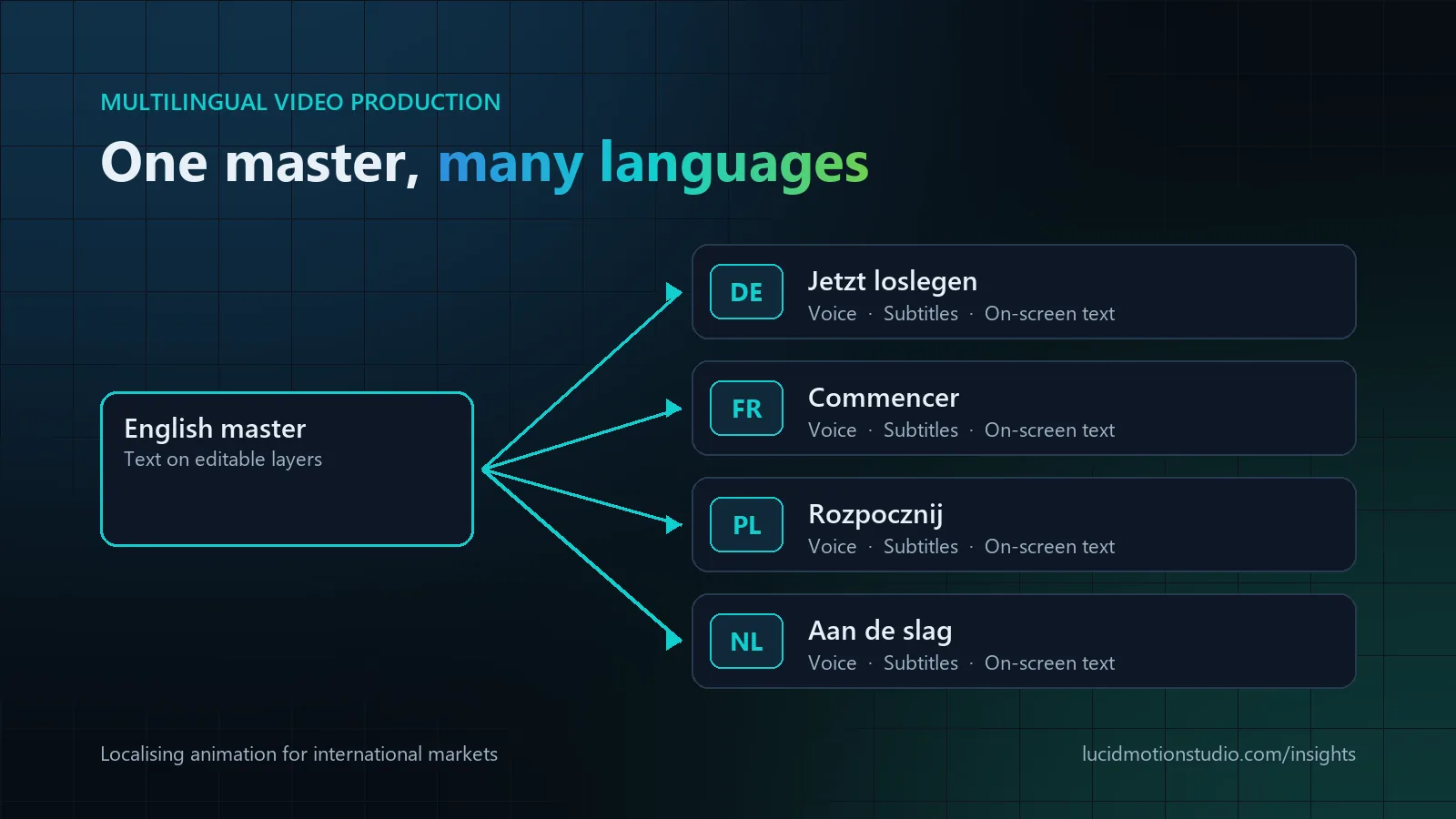
Multilingual video production means planning one animated master so that each language version needs new voice, subtitles and on-screen text rather than a rebuild. Translation alone is rarely enough: script timing, text length, typography, examples and tone all need adapting, and every version should be reviewed by someone in the target market. The biggest savings come from deciding the languages before the script is written, keeping all text on editable layers and recording voice separately from music and effects.
Key facts
- Translation, localisation and transcreation are different jobs with different costs
- Text grows in translation. W3C guidance citing IBM data: short English strings can end up two to three times as long
- Voice or subtitles depends on the placement; training and detailed visuals usually need voice
- Subtitle norms: Netflix's English guide uses 42 characters per line and up to 20 characters per second for adults
- Captions for prerecorded video are a Level A requirement in WCAG 2.2 (success criterion 1.2.2)
- Plan languages up front: text layers, timing and fonts built for localisation make each version cheaper
Translation, localisation and transcreation: what each one changes
The three terms are often used interchangeably, but they describe different amounts of change and are priced differently.
| What changes | When it is enough | |
|---|---|---|
| Translation | The words, as close to the source meaning as possible | Technical, legal and training content where precision matters most |
| Localisation | The words plus everything around them: voice, on-screen text, number and date formats, examples, imagery and timing | Most marketing, product and corporate video |
| Transcreation | The message is rewritten for the market, sometimes with new scenes or a new concept | Campaigns built on wordplay, humour or culturally specific ideas |
Most business video sits in the middle. A product explainer for German buyers rarely needs a new concept, but it does need a German voice, German on-screen text that fits the layout, and examples that make sense in Germany.
Decide the language strategy before you write the script
Localisation costs least when it is designed in from the start. Before scripting, agree:
- Which markets, and which variant of each language. French for France and French for Quebec differ in vocabulary and voice casting, and so do Dutch for the Netherlands and for Flanders.
- Voice, subtitles or both for each placement.
- Who reviews each language. Ideally a colleague in the market who knows the product, not only a translator.
- What must stay identical across markets, such as safety instructions or legal statements, and what may adapt.
Voiceover, subtitles or both?
| Option | Works best for | Watch out for |
|---|---|---|
| Subtitles only | Social video, internal updates, many languages on a limited budget | Viewers split attention between text and image, so detailed visuals become harder to follow |
| Voiceover | Explainers, product demos, training and any video with detailed visuals | Each language needs casting, recording and re-timing |
| Voiceover plus subtitles | Training and compliance, accessibility, sound-off playback | Subtitle files must match the localised voice, not the English script |
Captions are also an accessibility requirement in many contexts. WCAG 2.2, the W3C's web accessibility guidelines, lists captions for all prerecorded audio in synchronised media as a Level A success criterion (1.2.2), the most basic level of conformance.
Write an English script that localises well
- Avoid idioms and puns that only work in English. "Hit it out of the park" has to be rewritten, not translated, for every market.
- Keep sentences short and literal. They translate more predictably and are easier to re-time.
- Leave timing headroom. Text translated from English into most European languages gets longer, and voiceover tends to follow. A script written to fill exactly 60 seconds in English leaves no room.
- Separate words from images. Do not hang a joke or a key message on text inside the artwork, such as a word on a sign the narration refers to.
- Mark what must not change: product names, feature names that must match the localised interface, and regulated statements.
- Agree a glossary of product terms and their approved translations before translation starts.
Script timing: when the German version runs long
When a localised voice track runs longer than the English one, there are three ways to absorb it, roughly in order of preference:
- Edit the translation. A good adapter shortens without losing meaning, letting the visuals carry what the words no longer say.
- Re-time the animation. Scenes can be held or stretched for each language, one of animation's main advantages over filmed video. Scenes built with short pauses between beats make this much easier.
- Speed up the delivery slightly, but only while it still sounds natural. A rushed voice undermines trust faster than a slightly longer video.
On-screen characters who speak with lip sync are the hardest case, because each language needs new mouth animation. When several languages are planned, narration over characters is usually more practical than dialogue.
On-screen text, typography and layout
On-screen text breaks more localised videos than voiceover does. The W3C's guidance on text size in translation, citing IBM figures, shows that expansion from English depends heavily on length: strings of up to 10 characters can end up two to three times as long, while text of more than 70 characters averages about 1.3 times the English length. Short labels, buttons and titles, which animation uses constantly, are the ones that grow most.
- Design text boxes for the longest language, not for English. If German is in the plan, test layouts with real German text at storyboard stage.
- Check the font's character set. Polish needs letters such as ą, ę, ł, ń, ś, ź and ż; German needs ß and umlauts; French needs accented capitals. A display typeface that lacks them forces a font change late in production.
- Follow local conventions. German, French, Dutch and Polish use a comma as the decimal separator, and French typography conventionally places a non-breaking space before colons, question marks and exclamation marks.
- Keep text on live, editable layers in the project, never baked into rendered images or illustrations.
- Plan for software screens. If the product interface is itself localised, the video should show the localised UI, which means recording or recreating screens per language.
Localising English animation into German, French, Polish and Dutch
Each market has its own habits. These notes are starting points to discuss with your in-market reviewers, not fixed rules.
| Language | Practical points |
|---|---|
| German | Long compound nouns strain narrow text boxes and short titles. B2B content commonly uses the formal "Sie". Audiences in Austria and Switzerland notice terms that only Germany uses. |
| French | Decide early between French for France and Canadian French, because vocabulary and voice talent differ. The formal "vous" is the usual B2B default. Typography conventions differ from English. |
| Polish | Diacritics need full font support. Grammatical cases mean that text built from templates, such as a product or company name dropped into a sentence, often has to be rewritten rather than substituted. Choose a formal or informal register early and keep it consistent. |
| Dutch | Dutch in the Netherlands and Flemish Dutch in Belgium differ in vocabulary and accent, so cast voices for the actual audience. Many Dutch brands address customers informally with "je", but conventions vary by sector. |
Localisation-ready project files: what to ask your studio for
- A text-free master, or project files with every text element on its own editable layer.
- Separate audio stems for voice, music and sound effects, so a new voice can be mixed against the original music and effects.
- Subtitle files (SRT or WebVTT) for each language, rather than captions burned into the only master.
- Font details and licences for every typeface, confirmed for the languages planned.
- A script and timing sheet showing which line plays over which scene.
- Agreement on source files, if you might localise later with another supplier or in-house.
If an existing video has no project files and its text is baked into the artwork, the affected scenes must be rebuilt for every language. That is why localising an older video can cost more than expected.
A multilingual video workflow with quality control
- Approve the English master, or at least its script and storyboard, before translation starts, so late changes do not multiply across languages.
- Translate and adapt the script using the glossary, then have it reviewed by someone in each market.
- Cast and record the voice for each language, with a pronunciation guide for product and company names.
- Re-time and assemble each version: replace text layers, adjust holds and check every line break.
- Review the video, not the spreadsheet. In-market reviewers should watch the finished localised cut, because problems with timing, line breaks and tone only show up there.
- Check subtitles technically: line length, reading speed and sync. Netflix's English timed-text guide, for example, sets 42 characters per line and up to 20 characters per second for adult programmes, and comparable limits are a sensible reference for business video.
- Sign off each language with the market owner.
Budgeting multilingual video production
Costs rise with every language, but not evenly across the production. The script, storyboard, design and most of the animation are paid for once. What repeats for each language:
- Translation, adaptation and in-market review.
- Voice casting and recording, if the version is voiced.
- Replacing on-screen text and fixing layouts, which depends on how much text the video shows.
- Re-timing, subtitle files and the final export of each version.
- Rebuilding any interface or text that was baked into the artwork.
The biggest saving is planning languages from the start. Layouts, text layers and timing built for localisation make each extra version a fraction of the original effort, while versions requested after delivery often require rework. When you ask for quotes, list every language you expect, even those planned for later, so the studio can price each version separately.
How Lucid Motion Studio produces language versions
We produce voiceover and subtitle versions from one approved master, and plan on-screen text for translation at storyboard stage so each version is efficient. Our project experience includes German, French, Spanish, Swedish, Russian and Polish, and your team, or a reviewer you nominate, approves each language before delivery. Language versions are available for explainer videos, corporate videos and training videos, and agencies can brief us to deliver in their client's languages under their own brand through our white-label service.
Sources
Related reading
Common questions
How much longer is German text than English?
Is AI dubbing good enough for business video?
Should training videos be dubbed or subtitled?
Can you localise a video we already have?
Taking a video into new markets? Plan the versions with us.
Tell us which markets and languages you need, and share the script or existing video if you have one. We will recommend voice, subtitle and on-screen text versions, and send a fixed-price quote in writing within 24 hours.